Retool
This is the current Plainterms pattern for one Retool app plus one Retool Workflow. It uses Retool’s REST API resource and webhook trigger terminology, and only the Plainterms API/webhook contracts that exist today.
Create one Retool REST API resource for Plainterms:
- Base URL: your Plainterms app origin.
- Authentication: Bearer token using the Plainterms organization API key.
- Global header:
Authorization: Bearer <Plainterms API key>.
The API key identifies the organization, not a user. The upload query passes
user_email so Plainterms can set document ownership, dashboard visibility,
and webhook uploaded_by attribution. Pass customer_document_id when Retool
or your CRM has a stable quote/document ID, and reuse that same value whenever
the user retries or re-uploads the same logical document.
Upload Query
Section titled “Upload Query”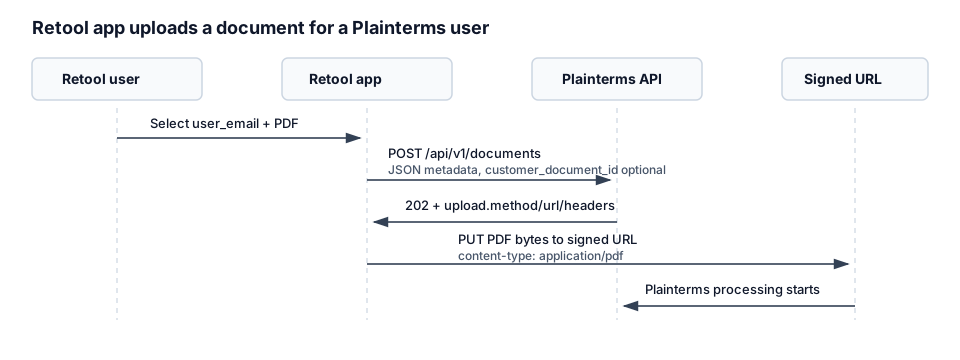
- The Retool user selects a Plainterms user email and a PDF.
- A Retool REST query sends JSON metadata to
POST /api/v1/documents. - Include optional
customer_document_idfrom the Retool row, CRM quote, or policy document record when you want stable downstream correlation. Do not generate a fresh value inside the upload button handler for each click. - Plainterms returns
202with areservationobject describing what happened. Dispatch onreservation.next_action:"upload"means the response includes a signed storagePUTURL;"none"means the content is already satisfied server-side — skip the upload and poll the returned document instead (see Handling Duplicate Uploads). - When an
uploadobject is present, Retool uploads the PDF bytes to that signed URL withcontent-type: application/pdf.
Retool REST queries support JSON bodies for the reservation call and raw or
binary bodies for the signed upload. Retool file components expose .value;
adapt that value to the binary upload query your Retool app uses.
Stable Customer Document IDs
Section titled “Stable Customer Document IDs”Treat customer_document_id as the Retool or customer-system key for the
logical quote/document, not the upload attempt. Store it on the source row or
derive it deterministically from the source record before calling
POST /api/v1/documents.
Good Retool patterns:
- Use the CRM quote ID already shown in the selected table row.
- Use a policy-system document ID returned by the upstream system.
- Derive a deterministic content key from a customer record and document slot that your app owns.
Avoid values created with uuid() or Date.now() inside the upload action.
Those values rotate on retry. If the same PDF is re-uploaded with a new
customer_document_id, Plainterms may return a 409 identity conflict instead
of treating the request as a duplicate or retry for the existing logical
document.
Polling And Downloads
Section titled “Polling And Downloads”After upload, poll one of:
GET /api/v1/documents/{documentId}GET /api/v1/documents/custId-{customerDocumentId}
The metadata response includes document.polling and document.download.
When document.download.available is true, fetch document.download.url
with the same Plainterms API key. The URL is an absolute URL to
/api/v1/documents/{documentId}.pdf; it is not an anonymous signed link.
Workflow Webhook Trigger
Section titled “Workflow Webhook Trigger”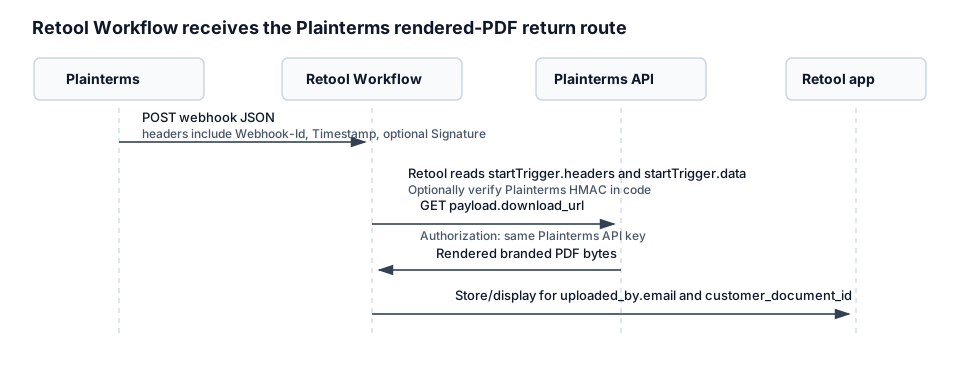
- Plainterms sends an outbound webhook to the Retool Workflow webhook URL.
- Retool exposes the request as
startTrigger.headers,startTrigger.pathParams, andstartTrigger.data. - If
startTrigger.data.download_urlis present, use the same Plainterms REST resource/API key toGETthat URL. - Store or display the rendered PDF for the Retool user record that maps to
uploaded_by.emailandcustomer_document_id.
Retool recommends an X-Workflow-Api-Key for authenticating workflow webhook
triggers. That protects the Retool URL; it is separate from Plainterms’
Webhook-Signature. If your integration requires Plainterms HMAC verification,
verify Webhook-Signature: t=<timestamp>,v1=<hmac> over
<timestamp>.<raw JSON body> in code before trusting the payload.
Correlation
Section titled “Correlation”document_idis the Plainterms document UUID.customer_document_idis the caller’s stable quote/document key from upload. Reuse the same value when the same quote/document is uploaded again.uploaded_by.idanduploaded_by.emailidentify the Plainterms user matched from uploaduser_email.- The same
customer_document_idcan be used later with/api/v1/documents/custId-{customerDocumentId}andPOST /api/v1/documents/confirm.
Current Boundaries
Section titled “Current Boundaries”- There is no public webhook configuration endpoint today.
- There is no public API-key management endpoint today.
- There is no public document listing/search endpoint today.
- There is no multipart Plainterms upload endpoint. When an upload is
required (
reservation.next_action: "upload"), it uses the signed storagePUTURL returned byPOST /api/v1/documents. - Do not send
uploaded_byin the document request. Useuser_email. - Webhook
download_urlvalues require the same Plainterms API key and do not includedownload_url_expires_at.
For exact request/response shapes, see Public API. For webhook payload fields and signature verification, see Webhooks.